
From talking tax to taking action: reflecting on Tax Justice Scotland’s first event
If we don’t seize the narrative on tax, who will?
By Allan Faulds, Senior Policy Officer of the Health and Social Care Alliance Scotland, and a member of Tax Justice Scotland’s Campaign Steering Group
Last month, the Tax Justice Scotland campaign held our first ever major event, “Talking Tax: The Role of Tax in a Fairer and Greener Future”. Chaired by journalist (and broadcasting legend) Bernard Ponsonby, it was an opportunity to bring supporters together to discuss why tax justice is so essential and to share ideas on how to achieve it.
Watch an overview of the event
The opening keynote from Professor Angela O’Hagan, Chair of the Scottish Human Rights Commission, set out the stakes – she described tax as “a tool for dignity and equality, not just revenue.” Despite obligations on governments under the International Covenant on Economic, Social and Cultural Rights (ICESCR) to use the ‘maximum of their available resources’ to progressively realise human rights, she noted an erosion of public services and quality of life in Scotland. Professor O’Hagan also highlighted the perception of tax as “a political bogeyperson” and the problems of treating fiscal policy overall as being a technocratic space, rather than a participative and democratic one.
A panel of speakers then put the need for tax justice into a Scottish, UK and International context.
For Scotland, Future Economy Scotland’s Laurie Macfarlane explained how necessary increases in health, social care and social security spending are helping to create a major forecast gap in Scotland’s public finances. He described the tax system as “dysfunctional” and warned that the Scottish Government must use their own tax powers rather than hope the UK Government would provide funding.
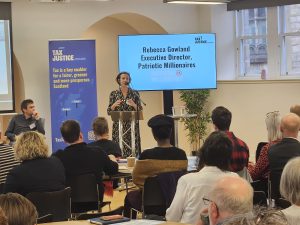 At the UK level, Rebecca Gowland from Patriotic Millionaires UK punctured the myth of top rate taxpayers fleeing the country, pointing out that 80% of the UK’s millionaires support a 2% wealth tax. She welcomed the fact that wealth taxation is now part of the national conversation and highlighted a package of fair UK wealth tax measures to raise up to £60bn per year.
Finally, looking internationally, Alex Cobham from the Tax Justice Network described how a staggering $492 billion (roughly the annual salary of a nurse every second) is lost globally to tax havens every year, a quarter of which passes through the UK’s overseas territories. Alex described fairer taxes as our under-used “social superpower”.
Delivering the day’s second keynote, Faiza Shaheen from Tax Justice UK argued that the public had a very strong sense of the system being rigged, and that tax is part of that. With around three-quarters of the public supportive of a wealth tax, she felt that a tide had turned but that politicians needed to catch up. There was advice to take away: don’t lead conversations on tax with technicalities or describe tax as a “necessary evil”, and don’t be spooked into silence by complexity.
Ruth Boyle from the Poverty Alliance shared Tax Justice Scotland’s new paper, Scotland Demands Better on Tax, outlining the campaign’s priorities for all political parties ahead of the Scottish election. These include replacing the outdated and unfair Council Tax and combatting deep wealth inequality through the tax system.
Watch: Scotland Demands Better on Tax
Although Bernard Ponsonby’s sharp questioning, particularly on Council Tax, put all of the panellists under pressure, it’d be fair to say there were no real surprises from the political panel.
Watch the full political panel
The SNP’s Ivan McKee MSP, Minister for Public Finance, defended the Scottish Government’s record on tax whilst arguing a lack of consensus had been the key barrier to Council Tax reform. Mark Griffin MSP for Labour agreed on the need for consensus whilst cautiously indicating general support for local tax reform. New Green Co-Leader Ross Greer MSP was perhaps most combative, arguing Council Tax reform was long overdue and challenging the other MSPs for refusing to back his recent amendments to begin the property revaluation necessary for any reform.
While not representing any political party (note: the Conservatives and Liberal Democrats were invited, but didn’t send a speaker), Andy Maciver from Message Matters questioned whether universalism was always the best approach to service delivery, and noted an increase of expenditure on public services from 43% to 53% of GDP over the course of devolution.
However, the most striking contribution of the day came not from the politicians or the policy wonks, but from the front line of community organising. In fiery speeches that first introduced and then reacted to the political panel, Heather Kay, Manager of the Star Project in Renfrewshire, laid bare the grim realities of poverty and reminded everyone that the cost of systemic inequalities and service failure is measured not just in pounds but in lives.
Watch: ‘Scotland is not a poor country’
“Let’s be clear”, she said: “Scotland has the resources. We are not a poor country. The issue is how those resources are shared. A fairer Scotland is possible. But it requires political courage. It requires a tax system designed not to punish the poorest, but to protect them.”
Although the event was a well-attended and energising opportunity to get people talking about tax, the need for urgent action was never far from the discussion. And with crunch UK and Scottish Budgets fast approaching, tax justice must be high on the agenda.
Watch: event participants’ views on tax
And here’s one last takeaway from the event: if we don’t seize the narrative on tax, who will?
This event was supported by the Wellbeing Economy Alliance Scotland with funding from The Robertson Trust. It was also funded by contributions from Oxfam Scotland, The STUC, The Poverty Alliance and the Scottish Women’s Budget Group.